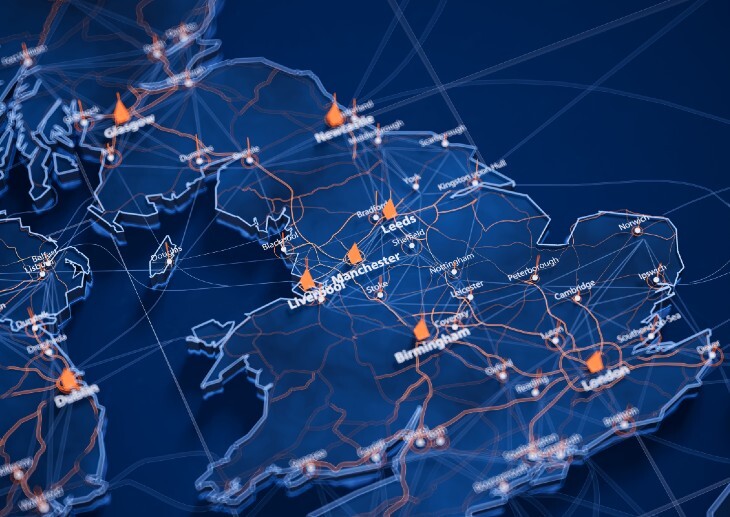
‘Everything happens somewhere’ – a truism that underpins the power of any mapping activity, and one which can help unlock some of the most complex challenges facing the NHS. From planning services and pathway design to tackling climate change and achieving net zero, geospatial analysis can support us in making sense of the huge volumes of data that now exist, providing commissioners and providers with a clear understanding of the impact of their decisions on communities and patients.
The 10 Year Health Plan demands a new scale of change across the health system, overlaying a familiar pattern of continuous improvement as commissioners and providers seek better ways to address population health challenges. The three shifts – analogue to digital, hospital to community and sickness to prevention – all impact, to some degree, where and how patients will access services in the future. Against a backdrop of resource pressures, we need to make the right decisions first time but with so many simultaneous moving parts, how do we make confident changes?
Lack of data is rarely the problem – making sense of the data we do have access to, however, is a genuine challenge. Pressures and complexities are such that commissioners need to be able to layer and interpret several different data sets, including non-health data such as transport, education and census data.
Using geospatial analysis to map these data sets can provide this much-needed clarity. In most cases, the raw information may be the same, but the approach enables people to visualise and interact with information, model different scenarios and gain a detailed understanding of how service changes will impact communities. It is particularly useful in tackling the following challenges.
- Managing service closures or relocations: According to the Royal College of GPs, the number of open and active GP practices in England has fallen by over a thousand in eight years while the number of registered patients in England has risen by over 4.8 million. Although some of these closures will be to do with mergers and relocations, any change to a GP surgery location is undoubtedly disruptive for patients. Geospatial analysis enables commissioners to find the best possible alternative for patients based on a wide range of criteria. This includes mapping travel routes, including public transport provision based on actual timetables, taking varying GP practice capacities into account as well as keeping family groups together. In cases where patients cannot receive their preferred option, ICBs can at least evidence and visually illustrate why a patient may have been allocated a particular practice.
- Guiding investment decisions: Commissioners are often partially reliant on assumptions when providing services or addressing inequalities. But people don’t always access services where or how you expect them to. In developing the National Dental Tool for NHS England, we have included several data sets which enable regions or ICBs to analyse down to practice level the distance people travel to access services and the performance data of each dental practice. This can be combined with demographic data to understand the local population makeup and potential inequalities. With this understanding, investment in enhanced provision can be directed where it will have most impact.
- Developing scalable solutions: Geospatial methodology is inherently scalable. Once the core data sets have been identified, the framework required to understand service use, accessibility or take-up can be applied at scale. This becomes increasingly important as greater levels of neighbourhood commissioning take place alongside local, system and national provision. But this doesn’t just apply to service needs. To reach net zero and support Green Plans, mapping data is also being used to support carbon footprint calculations based on workforce and patient travel analysis. Geospatial analysis could also help to identify NHS estate locations that would be suitable for solar panels on an individual building, trust or ICB-wide level, in addition to calculating energy potential based on roof orientation.
- Optimising multi-site care delivery: The use of Geospatial technology is already relied upon to determine the most effective and efficient ways to deliver care, optimising elements such as workforce time and availability, medicines use, carbon footprint, cost and speed. Mapping was crucial in planning the national vaccination programme during the COVID-19 pandemic and continues to be used for planning vaccinations for housebound patients. This approach enables the most vulnerable patients to receive care quickly and efficiently, while ensuring vaccine vials are used up within their six-hour shelf life once opened.
The use of geospatial analysis in healthcare has come a long way since physician, John Snow, first developed a dot map to visualise cases of cholera around the Broad Street pump in 1854. The use of data to inform decision making in the NHS has advanced rapidly – and with it, the range and complexity of information we must decipher. Alongside the three shifts, the 10 Year Health Plan includes a commitment to address the current inequalities in access to healthcare and patient outcomes. Doing so will require tough choices which must be evidence-based to ensure they are effective, justifiable and deliver the best solution for local communities. As ICBs cluster and neighbourhood health centres take shape, using geospatial analysis to accurately map, model and assess different options, could be vital in helping commissioners effectively navigate the complex challenges ahead.
By Ian Maxfield, Associate Director, and Richard Sanders, Business Development Manager, Geospatial Services at NHS South, Central and West
To mark World GIS Day, South Central & West CSU is running a free webinar ‘Mapping the Next Decade: Navigating the NHS 10-Year Plan with GIS’ on 19 November at 10am. Register here