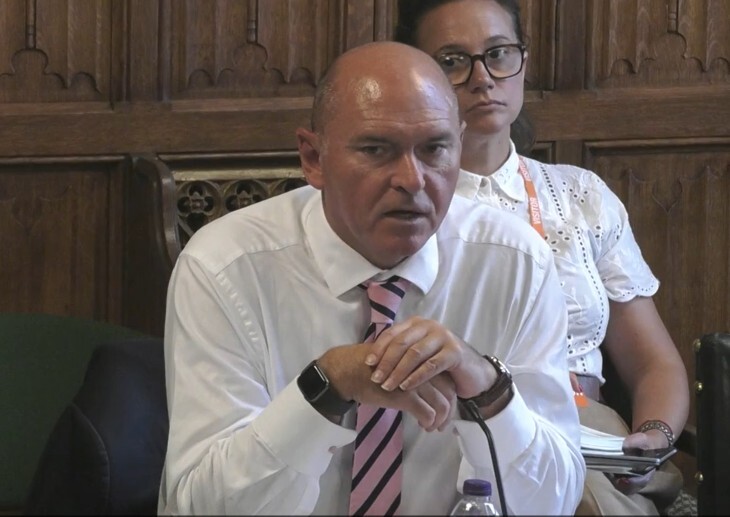
NHS England is in talks with the Treasury about how the redundancy process across ICBs will be funded, according to chief executive Sir Jim Mackey.
Speaking at a Health and Social Care Committee (HSCC) meeting this afternoon (9 September) on the work of NHS England, Sir Jim was asked about where the money would come from.
MP Greg Stafford asked: ‘Clearly several ICBs aren’t clear where that money is coming from because they’ve paused voluntary redundancy schemes or decided to postpone reductions in staff to 2026/27 financial year due to the uncertainty. So when are you going to get clarity about how they’re going to pay for these redundancies?’
Sir Jim answered that he met with ICB chairs and CEOs last week.
‘We talked through the situation that we’re in with government in the negotiation about how redundancies will be funded,’ he said.
‘We talked through [that] there are a couple of paths and scenarios for this to work and as soon as this issue is resolved, which is hopefully in the next few weeks, we’ll go back to them and agree ICB by ICB how they can then proceed with their plan.’
He added that some have their plans ‘in hand’ and can progress anyway. But that they had been ‘absolutely clear’ where NHS England stands now and what needs to happen over the next few weeks.
When asked about the cost of redundancies and how much it would be, he added that it was ‘subject to a discussion with the Treasury that’s very active and live at the moment.’
On the abolition of NHS England, Sir Jim also revealed that they’d had over 3,000 applications for voluntary redundancy.
‘If we’re able to cost all that fully, which is in process, that’s a significant cost, but also with a really significant saving downstream as well,’ he said.
He added that they are trying to make sure it comes from the overall spending review period envelope, but ‘we have a bit of flexibility over time in terms of the upfront costs versus when the savings are realised’.
It comes as the NHS league tables for trusts have been published today, which health leaders have warned are of ‘limited use’ to patients.