Primary care contracts must be aligned for neighbourhood health to succeed, leaders have said.
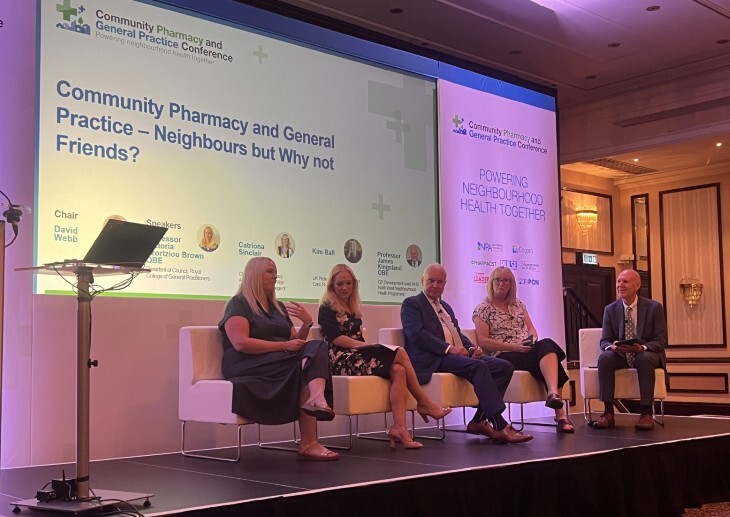
Speaking at the inaugural Community Pharmacy and General Practice conference on Monday, health leaders said that GPs and pharmacies are often set up to compete with each other rather than collaborate – particularly around vaccination services.
Leaders highlighted the flu vaccine as one example of where pharmacists and general practice were pitched against each other.
Doctors’ Association UK GP co-lead Dr Steve Taylor told a session on vaccines: ‘I think we were set up to compete with each other in a way which was not right, and that’s fundamentally the problem here.
‘From a commissioning point of view, if it’s set up more collaboratively with guaranteed no losses, but actually everyone wins, and the most important people that win are the communities that we serve.’
Former president of the Royal College of GPs, Dr Richard Vautrey, highlighted that another area of tension was that pharmacists are tasked to deliver the meningitis B vaccines while GPs are not.
‘One of the things that the government needs to do is build collaboration and support. My concern is the recent decision around meningitis B to just feed a pharmacy delivered scheme rather than your practice scheme works against that.
‘We have to collaboratively challenge government when they do that, when they make those decisions, to say that isn’t going to work for our patients and for the collaboration of our primary care colleagues. We do need to see people working together, not being pushed apart through contractual changes that government introduced,’ he said.
Meanwhile, chief place and transformation officer for the Cornwall, Isles of Scilly and Devon ICB cluster Dr Chris Reid said: ‘I think contracts should be a means to deliver population health and deliver the outcome [of making] it easy for us.’
He said that most of the contracts seem to ‘get in our way’ for general practice and pharmacy because they have got ‘siloed contracts’.
Dr Reid added that the neighbourhood heath model will have to ultimately deliver a system impact and that contracts needed to be adapted so primary care can work as one team.
Community Pharmacy England’s director of NHS services, Alastair Buxton, said that primary care has never been funded to develop teams ‘in totality’ and pointed out that this problem needs to be solved first.
He said: ‘We’ve got to start at a really basic level, we have never in primary care been funded to develop teams in totality.
‘Primary care networks [PCN] have had funding, lots of funding, relatively, to get general practices and their wider teams that help healthcare professionals working together, and that’s fantastic, because that’s really, really important as a foundation.
‘But actually, the other bits of primary care – we’ve never had that funding.’
Mr Buxton added: ‘Our colleagues in secondary care have a greater ability to make time in their days, and to do that as salaried individuals, it’s more complex contractually for us, but I really think we need to solve that problem to start with, honestly.’
When asked what NHS England could do to support collaboration, the chief pharmaceutical officer for England, David Webb, said that it all starts with local relationships.
‘There’s a really important thing about trust and confidence in all of this, and that, in my view, typically relates to relationships that develop more locally, but that’s not to negate the point about other things that can be supportive.
‘The professional bodies also have a really big role to play, as we have a new Royal College of Pharmacy on the pitch now… there are different levels of intervention, but I think the really crucial thing is the relationships at a local level.’
Also speaking at the conference on Monday, President of the Royal College of GPs Professor Victoria Tzortziou Brown agreed it was important to align resources, and incentives with pathways.
She said that rather than developing new pathways ‘why don’t we work on existing pathways and think how we can redesign them in a better way, so that we can give you the expertise of the wider teams’.
She added: ‘Sometimes things instinctively feel right, but actually we don’t see we are getting something wrong, we need to continuously evaluate. And finally we need to align, provided we have developed the pathways, we need to align resources and incentives within those, because…when incentives go against each other, of course, we don’t achieve the best outcomes for patients.’